



Research-Grade Silicone Compression Molding | Precision Parts
What is Research-Grade Silicone Compression Molding?
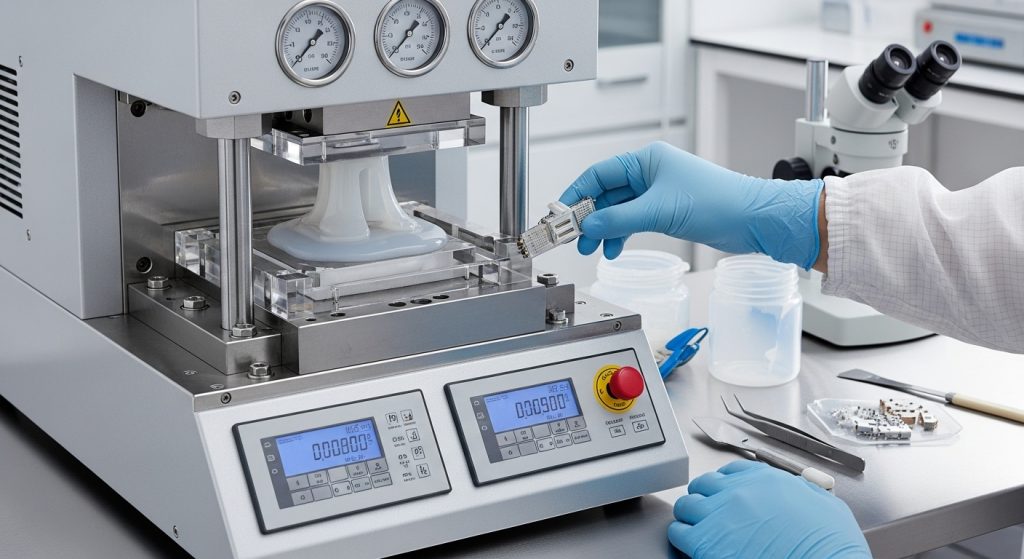
Research-grade silicone compression molding is a production technique in which the uncured silicone is put into a mold cavity, pressed between heat and pressure, and allowed to cure to form the final parts. It is a very flexible process that can be used in complicated shapes, tolerances, and high-volume production, and is suited best to laboratory and medical uses.
Key Benefits Include:
- Manufacturing of silicone components of high accuracy with a tolerance of +-0.2mm to +-0.5mm.
- Ability to deal with high-volume production, having more than one cavity in a mold.
- The ability to be used with different silicone grades, such as medical silicone and industrial silicone.
- Small-seal, gasket, and large-industrial component flexibility in design.
This method guarantees that every part is of uniform quality, which is essential in silicone compression molding of research quality to be used in a laboratory.
Silicone Compression Molding Materials
The selection of material is very important in research-grade silicone compression molding. The choice of materials depends on their characteristics, such as temperature-resistant materials, elastic materials, chemical compatibility, and durability. Common materials include:
- Silicone of medical grade: Biocompatible, can be sterilized, suitable for medical and laboratory devices.
- Silicone industry: High stress, high temperature, and high-temperature resistant, used in automobile and consumer products.
- Thermoset elastomers: These are reliable throughout curing and can be molded accurately.
Research-grade custom silicone compounds may also be designed to attain a given level of hardness (Shore A 20-80) and other mechanical characteristics, which would guarantee maximum performance.
Compression Molding Process
The silicone compression molding technology is another technology that converts raw silicone to high-quality components with precision in a sequence of steps that are controlled steps.
- Design for Manufacturability (DFM) Review
Before printing, a DFM review is carried out by our engineers to determine the part design as feasible in compression molding. This process guarantees moldability, flow of materials, and tolerance, which minimizes the chances of production errors.
- Mold Making
Our molds are machined, tooled, and designed in multi-cavity with CNC machining, precision tooling, and multi-cavity. Molds are designed to be engineered with high-tolerance silicone compression molds and optimized with digital simulation, which can be used in the analysis of the flow of the silicone, which will flow smoothly and cure smoothly.
- Material Preparation
Raw silicone is weighed, ready-shaped, and done as per Shore hardness specifications. This measure will provide uniformity and minimize waste of materials.
- Compression Molding & Curing
The ready silicone is put into the mold, squeezed under pressure and heat, and cured. Individual curing of silicone parts and temperature regulation are carefully controlled with a tight tolerance, high dimensional accuracy, as well as uniform hardness.
- Mold Trial and Quality Inspection
Mold trials are done, and T1 samples are checked to ensure that they are working correctly, that they are of proper size, and that surface quality is good. This measure will guarantee that the custom silicone compression molds can be repeated reliably.
Benefits of Research Grade Silicone Compression Molding
Silicone compression molding has many advantages over other manufacturing methods:
- Medical, automotive, and research-quality silicone components that are durable and of high quality.
- Less expensive tooling than other types of molding processes.
- Malleability in making intricate forms into finer details.
- Large-scale manufacturing possibilities of multiple-cavity molds.
- Uniformity in the quality of parts, high tightness, and reproducibility.
The following advantages make it an ideal application in high-precision silicone molding in scientific research, medical-grade silicone molding, and experimental component production.
Research-Grade Silicone Compression Molding Uses
Research-grade silicone compression molding is very versatile, allowing it to be used in many industries:
- Medical Devices
Silicone components (seals, tubing connectors, and implantable components) used medically must meet the highest quality assurance criteria required in the laboratories. Biocompatibility, accuracy, and uniform mechanical properties are guaranteed by our process.
- Laboratories and Scientific Inquiry
Laboratory equipment frequently requires difficult-to-make silicone parts that have tight tolerances. Our molds have been used to produce repeatable and dependable parts in microfluidic channels and test tube seals, among other things.
- Automotive and Aerospace
The silicone parts used in these industries need to be resistant to high temperature, chemical, and mechanical stress. Our high-performance silicone molding is able to fulfill the requirements of lightweight, durable, and thermally stable components.
- Consumer Electronics and Goods
Consumer electronics, household appliances, and wearable devices mainly use flexible, durable, and precise silicone components. Complex geometries with fine surface finishes can be produced using our custom silicone tooling.
Technical Capabilities
SunOn Mould's experience in silicone compression molding to research grade:
- + -2mm Precision High tolerance silicone compression molds.
- Efficient mass production by multi-cavity silicone molds.
- Silicone complex geometry molds are CNC-machined.
- Thermoset elastomer remodeling of stable and repeatable parts.
- Mold flow analysis of defect-free production with silicone.
- Medical and research-compliant, philosophically ISO-certified silicone compression molding.
- Quick prototyping and T1 sample fabrication for rapid design validation.
These will allow our customers to increase the volume of their research prototypes into large volumes of production without compromising their quality.
Silicone Compression Molding and Innovation, and Technology
Our work combines the latest technologies to improve the efficiency and quality of parts:
- Silicon mold design in silicone mold design. Digital simulation to optimize material flow.
- Complex mold features: Additive manufacturing.
- Precision and speed of automated laboratory silicone parts production.
- Hi-tech silicone mould temperature regulation to provide uniform curing.
- Silicone molding solutions that are smart in waste reduction as well as cycle time.
These breakthroughs are used to make sure that custom silicone compression molds are of the best performance, life cycle, and reproducibility.
Conclusion
Research-grade silicone compression molding is required in industries that need accuracy, high wear and tear, as well as high repeatability. SunOn Mould is established on the principle of providing quality, technology, and precision, and is the preferred choice of research-grade silicone compression molding, producing components that withstand the highest standards of laboratory, medical, and industrial usage.
