



Custom Die Casting Tooling: H13 vs. H11 Tool Steel Selection
For Custom Die Casting Tooling, steel selection should start with the expected failure mechanism. A gate insert exposed to erosion needs a different assessment from a slender core prone to fracture or a large cavity developing heat checks.
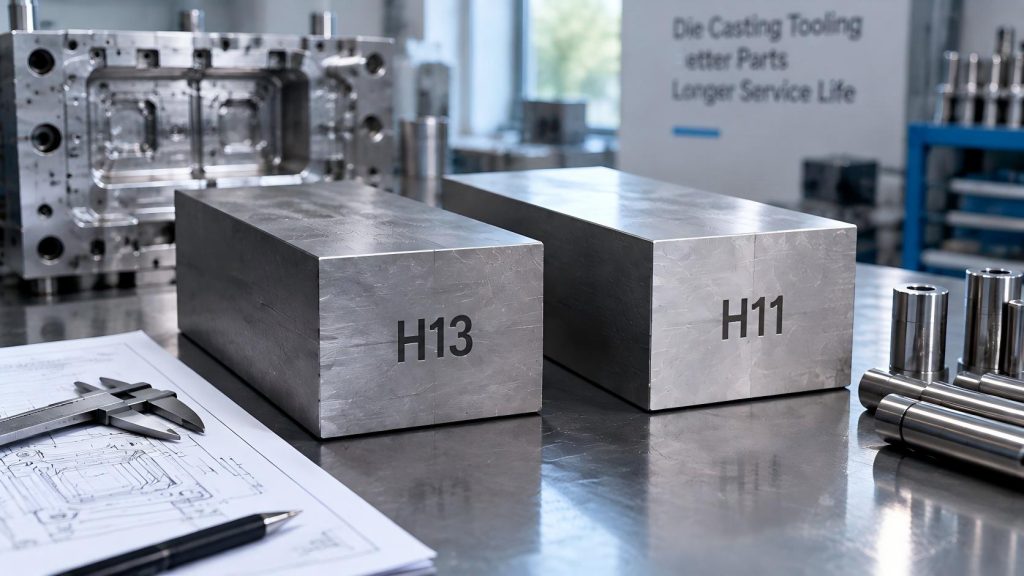
SunOn Manufacturing integrates DFM, mold-flow analysis, tooling, and production trials within our manufacturing workflow. This allows us to evaluate steel in combination with geometry and process. One of the materials we list is H13. We would need to research the sourcing and processing of H11 during the project review.
Diagnose Die Damage Before Specifying H13 or H11
Changing steel without identifying the mechanism of damage most likely will not address the problem.
| Damage Observed | Likely Damage Mechanisms to Evaluate | Engineering Priority |
| Surface heat checking networks | Repeated temperature gradients, cyclic strain, surface damage | Improve thermal control and check material |
| Deep cracks or core fracture | Stress concentrations, lack of support, insufficient toughness | Geo/load/heat treatment review |
| Gate-area erosion | Direct metal impingement, velocity, local temperature | Optimize gate and consider replaceable gate inserts |
| Local deformation | Excessive temperature, softening, compressive loading | Check cooling, hot-strength and lubrication |
| Soldering and difficult release | Alloy interaction, surface, temperature, lubrication | Process and surface treatments |
Heat checking, gross cracking, are the result of different mechanisms. Raising the hardness of the material at room temperature does not solve thermal fatigue. Uddeholm has a technical guide which addresses these issues.
H13 vs. H11: Compare Properties at Matched Conditions
Alloy Balance and Service Performance
H13 and H11 are hot-work chromium-molybdenum-vanadium steels. In conventional H13 the content of vanadium is higher, thus, affecting the formation of carbides, as well as the wear resistance. H11 is usually examined when greater emphasis is placed on toughness.
These tendencies do not establish a universal winner for Custom Die Casting Tooling.
| Property | H13 Selection Consideration | H11 Selection Consideration |
| Hot wear resistance | Established candidate for demanding die surfaces | Verify suitability for local erosion and wear |
| Toughness | Premium grades can provide substantial toughness | Candidate for fracture-sensitive components |
| Temper resistance | Check retained hardness after thermal exposure | Compare at equivalent exposure conditions |
| Thermal fatigue | Depends on steel quality, treatment, and temperature cycling | Requires the same system-level assessment |
| Thick-section performance | Verify core properties after heat treatment | Do not infer performance from small specimens |
Why HRC Alone Is Insufficient
Two inserts with equal hardness can have different toughness, carbide distribution, cleanliness, and residual stress.
Require comparable data:
• Impact toughness: Same specimen direction, notch, temperature, and hardness.
• Temper resistance: Same exposure temperature and duration.
• Through-section properties: Evidence relevant to actual insert thickness.
• Material condition: Separate conventional, ESR, and proprietary modified grades.
Compare Four Custom Die Casting Tooling Decisions
| Decision | Potential Advantage | Limitation |
| H13 vs. H11 | Align properties with dominant damage | Grade names cannot replace test data |
| Conventional vs. ESR steel | ESR can improve cleanliness and uniformity | Added cost requires verified quality benefits |
| Lower vs. higher hardness | Adjust toughness versus wear and deformation resistance | Excessive hardness can increase fracture sensitivity |
| Uniform vs. localized selection | Upgrade critical cores and gate inserts selectively | Requires controlled fits, support, and spare management |
For example, BÖHLER's H13-class W302 ISOBLOC combines ESR processing with hot-work properties. ESR remains one part of the specification; it does not guarantee service life.
Nitriding or coatings should address a defined surface problem. Neither compensates for defective steel or unsuitable heat treatment.
Match Custom Die Casting Tooling to the Production System
Section Thickness, Cooling, and Support
Large sections cool differently during hardening. A satisfactory surface hardness reading does not establish acceptable core microstructure.
The design review should address:
• Cooling-channel position and remaining steel thickness.
• Core-root radii, local thin sections, and backing support.
• Gate impingement and concentrated thermal loading.
• Spray patterns, cycle time, and restart temperature.
• Machine fit, shot capacity, and required clamping force.
SunOn provides die-casting capacity of 160 to 800T with a die-casting tolerance of ±0.05mm and a CNC machining tolerance of ±0.01mm. Those specifications require Feature-wise confirmations. In addition, critical bores and sealing faces should have agreed casting and machining requirements as well as assembly datums. Our DFM and flow-simulation stages ease this coordination.
Maintain Die Performance During Use and Maintenance
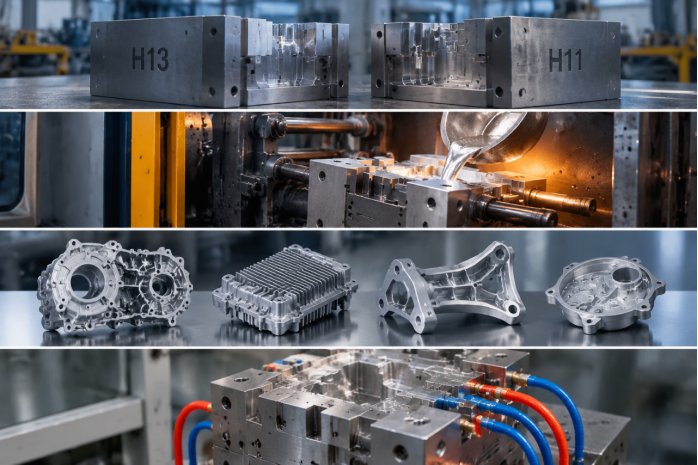
Each custom die casting tooling must include thermal allowances, specifications and approved material specification.
• Installation: Verify that the alignment, fit, support and thermal expansions are correct
• Start-Up: Carry out restart of an approved process heat cycle.
• Surface Integrity: Address EDM recast layers and grind damage.
• Consider tracking the erosion of die cavities and die land; shot count and cooling is essential too.
Repair: Evaluate crack depth post repair and decide the post repair treatment on the basis of the depth of the crack and the weldability.
Failure can occur if a damaged insert is replaced without correcting either of the following: the loading conditions or the thermal situation.
Verify Material Quality Before Tool Acceptance
Specify the applicable ASTM A681 requirements and agreed NADCA #207 acceptance criteria. NADCA's official listing identifies #207-2025 for die-steel procurement and heat-treatment acceptance. NADCA publication
Request furnace-batch traceability, chemistry, melting route, heat-treatment records, hardness mapping, and agreed inspection results. Confirm dimensional and casting performance through production-relevant trials. A material certificate alone does not validate the assembled tool.
Evaluate Cost per Accepted Part
Compare Custom Die Casting Tooling quotations with identical inspection, trial, spare-insert, and delivery scopes.
Tooling cost per accepted part = sum of initial tooling cost, maintenance cost, replacement cost, and agreed upon downtime cost ÷ accepted production quantity.
Indicate the meaning of service life to be first repair, insert replacement, or complete retirement and agree upon ownership and warranty liability.
Please provide SunOn with your drawings, specifications, alloy, production volume, and previous failure records. The information helps us identify an affordable steel grade and reasonable acceptance criteria for your next tooling project.
FAQs
Q1. Does SunOn provide Custom Die Casting Tooling for aluminum and zinc parts?
Yes. SunOn provides custom aluminum and zinc alloy die-casting molds, with services covering design analysis, mold manufacturing, assembly, trials, and production. Applications include automotive components, electronics housings, and industrial parts. SunOn services
Q2. Which steels does SunOn list for Custom Die Casting Tooling?
SunOn offers H13, 8407, and 4Cr5MoSiV1 among its die-casting tooling materials. Buyers should confirm the specific grade, material source, melting route, and heat-treatment requirements before approving the tooling specification. SunOn tooling materials
Q3. Can SunOn supply H11 instead of H13 tooling?
H11 is not explicitly listed on the reviewed SunOn material pages. SunOn states that additional materials can be sourced on request. H11 availability, lead time, and processing requirements therefore need project-specific confirmation. Material sourcing information
Q4. What information should I send SunOn for a tooling quotation?
Provide 2D drawings, 3D models, casting alloy, annual volume, critical dimensions, surface requirements, and the intended production equipment. For replacement tooling, include failure photographs, shot counts, and maintenance records to support the material discussion.
Q5. Does SunOn perform DFM and mold-flow analysis?
Yes. SunOn describes DFM and mold-flow analysis as part of its development process. Its published design activities include reviewing draft angles, radii, ejectors, parting surfaces, and gating to improve manufacturability before tooling production.
